search
Category

Featured

Two Top-Tier Scientists

By Featured, Mitochondria
resized_-_K.Garcia_2

Krista Garcia, photo credit Morgan Levine

In honor of their outstanding accomplishments and limitless potential, two USC Leonard Davis School doctoral students ended the school year with a major reason to celebrate.

Krista Garcia was one of only two social scientists in the last seven years to win the R36 National Institute on Aging (NIA) Aging Research Dissertation Award, which supports two years of dissertation work as well as providing funds for additional expenses.

“Nearly half of men and a third of women will develop cancer in their lifetime. However, it is unclear what the long-term effects of cancer and its treatment are on survivors,” Garcia said. “I hope to address this research void and to improve our understanding of the adverse physical and cognitive health outcomes following a cancer diagnosis in older adults, which can inform interventions and help identify at-risk groups.”

Crediting her advisor, Eileen Crimmins, as well as the insight and guidance of postdoctoral researcher Jennifer Ailshire and research administrator/program manager Linda Hall, Garcia expressed gratitude for the Multidisciplinary Research Training in Gerontology Program.

“The success of my application is attributed to my outstanding mentoring team and to the strong institutional support I receive here at the USC Leonard Davis School,” Garcia said. “I am very grateful and very proud.”

Laura Corrales-Diaz Pomatto, photo credit Christine McDowell/The Image Artist

Laura Corrales-Diaz Pomatto, photo credit Christine McDowell/The Image Artist

Fellow USC Leonard Davis School doctoral student Laura Corrales-Diaz Pomatto earned a National Science Foundation Graduate Research Fellowship, which will support three years of research with the possibility of additional expenses.

“This will provide me the opportunity to focus entirely upon research and to further explore the role of a mitochondrial stress response protein known as the Lon protease,” Corrales-Diaz Pomatto said. “I plan to solve the mystery of how it is regulated and to achieve one of my major goals: to be a part of a collaboration between gerontology and engineering to improve the aging process.”

Attributing enormous impact to the guidance of her mentor, Kelvin J.A. Davies, vice-dean of the USC Leonard Davis School, as well as to the discipline and camaraderie of rowing on USC’s crew team, Corrales-Diaz Pomatto says that being a Trojan has shaped her in more ways than she can count.

“The concept of ‘Fight On’ has become more than a school motto,” Corrales-Diaz Pomatto said. “It embodies how I hope to approach life—that regardless the challenges, I will continue to persevere.”

“With sterling records as students and scientists, both Krista and Laura represent the highest ideals of USC as well as those of the field of gerontology itself,” said USC Leonard Davis School dean Pinchas Cohen. “We are so proud that the National Institute on Aging and the National Science Foundation recognized how exceptional these two women are, and we can’t wait to see what they accomplish next.”

What’s Hot? Aging Research!

By Featured, Mitochondria

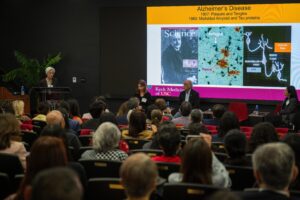
Trojans of all scientific stripes shone at the USC Leonard Davis School of Gerontology’s fourth annual interdisciplinary symposium, “What’s Hot in Aging Research at USC.”

Organized by USC Leonard Davis assistant professor Sean Curran and associate dean Maria Henke, the conference was held on Monday, April 22 under the subtitle “Integrated Approaches to the Study of Aging.”

“I’m so delighted to see such an incredible turnout to this event. There’s so much exciting new work being done at our School and at USC,” said Davis School dean Pinchas Cohen. “Aging is at the forefront of what we think about as a society; it’s where our resources are being channeled; it is the lens through which we see the challenges and opportunities of the future.”

Curran chaired the first session, entitled “Nutrition, Metabolism, Aging,” which examined the biology and genetics behind longevity. Fielding questions about growth hormone injections, organic food and the role of the mitochondria in cellular aging, USC Leonard Davis Valter Longo and David Lee as well as Biological Science’s John Tower provided the scientific basis for the day’s remaining programs.

The second session, “The Future of Aging,” contained speakers from the USC Leonard Davis School of Gerontology, chaired by Susan Enguídanos, who began the panel with a discussion of end-of-life care trends, transitions and trepidations. Next up was Elizabeth Zelinski, who discussed the brain’s changing cognition with age after describing the Flynn Effect, which shows steady generational improvements for 18-year-olds in their ability to do well on IQ tests.

“So, like you’ve always thought, you are indeed smarter than your parents,” she joked. “Like your kids think…they’re probably smarter than you.”

The panel closed with Tara Gruenewald discussing the role of generativity—or the care, concern and cultivation directed towards younger generations—in helping people age with greater reports of happiness and health.

Before breaking for lunch, Cohen surprised everyone by presenting the Dean’s Medallion to attendee Mike Yamano, chancellor of Tokyo’s Yamano College.

“This is the greatest honor we can give to our partners and supporters and I am honored to recognize the distinguished career and contributions of Mike Yamano. A true gerontology ambassador, he has helped revolutionize the field with his innovative recognition of the link between aging and aesthetics,” Cohen said. “To quote Mike’s lifelong friend and the head of the USC Leonard Davis School Board of Councilors, Dr. Richard King, ‘Mike is a visionary, an entrepreneur and, most of all, a person with a fine spirit. I am so proud to have him and Yamano College associated with the USC Leonard Davis School.’”

“Dr. Cohen, USC and attendees: I am so honored. Thank you—this is indeed a surprise,” Yamano said. “I have been surprised many times in my 77 years, but the best and most beautiful surprise is to see so many wonderful people studying gerontology.”

After a lunchtime networking session, the USC Leonard Davis School’s Caleb Finch discussed his recent “mummy study” of atherosclerosis. He also chaired the third session, “The Aging Brain,” which included his Davis colleague Mara Mather discussing the positivity effect of older adults’ cognition as well as Dion Dickman from Neuroscience covering homeostasis and plasticity.

The final session, “Emerging Scholars,” was moderated by Curran, who gave USC Leonard Davis School postdoctoral researchers and doctoral students an opportunity to present their work. Mafalda Cacciottolo discussed APOE isoforms, Jeff Laguna discussed a pain management smartphone app and Morgan Levine discussed her study on the unique health resilience of long-lived smokers. As the conference wrapped up, Jennifer Ailshire presented her study on air pollution and the aging body and brain, which was particularly of interest to Southern Californians.

“LA has the highest level of fine particulates in the country. We’re all a vulnerable population. There’s a daily growing body of evidence showing the harmful effects of particulate air pollution, including respiratory and cardiovascular damage and compromised brain health and development,” Ailshire said. “The good news is that this is all preventable. We can all do something about air pollution. We all deserve to breathe clean air, regardless of where we live.”

Once more, “What’s Hot in Aging Research” helped to enlighten and empower attendees not only to appreciate the amazing aging-related work being done across USC’s campus, but to also reaffirm their commitment to their own.

“There’s just something special about the Trojan spirit,” said Cohen. “As always, it’s our pleasure to highlight the world-changing work USC researchers in all disciplines are doing. What’s hot in aging? USC research is!”

Recovery for Liza

By Alumni, Featured
Dual degree USC Davis School of Gerontology alum Liza Cherney (’06, BSG; ’07 MSG) sustained major injuries at the 2013 Boston Marathon. After undergoing a number of surgeries, Liza is now recovering at home but needs our help and support. Liza has always proven herself a devoted, philanthropic Trojan—please join…
Read More

Hear We Are

By Featured

According to the World Health Organization, more than 360 million people around the world have disabling hearing loss, which includes one-third of all people over 65 years old and one-half of those older than 75.

To draw attention to this crucial area, the USC Emeriti Center, House Research Institute and USC Disability Services and Programs teamed up to present the 2013 Hearing Health Symposium at the USC Leonard Davis School of Gerontology on Friday, April 19.

“No matter what your age, hearing clearly makes all the difference in quality of life. That’s why we held the USC Hearing Health Symposium: to showcase multiple perspectives discussing research, resources and how to find the best treatment for different types of hearing loss,” said Janette Brown, executive director of the USC Emeriti Center.

(l to r) James Boswell, CEO of the House Research Institute; Janette Brown, PhD, executive director of the USC Emeriti Center; Pinchas Cohen, MD, dean of the USC Leonard Davis School; John House, MD of the House Clinic and House Research Institute

(l to r) James Boswell, CEO of the House Research Institute; Janette Brown, PhD, executive director of the USC Emeriti Center; Pinchas Cohen, MD, dean of the USC Leonard Davis School; John House, MD of the House Clinic and House Research Institute

“Today’s event represents a tremendous opportunity to engage so many in an incredibly important topic. In gerontology, we talk a lot about the spans—life span, health span, wealth span—but I’d like to coin a new term today: hearing span,” said Pinchas Cohen, dean of the USC Leonard Davis School. “Hearing loss is in essence, an age-related disease. We have to address this more closely in the gerontology community and I’m looking forward to a partnership with the scientists and attendees of today’s event.”

The three panel discussions—“Exploring Your Hearing Health,” “Latest Research, Communication and Effective Self-Advocacy” and “What’s New – Assistive Devices, Technologies, Community Resources”—were moderated by James D. Boswell, CEO of the House Research Institute, Charlotte Schamadan of the House Research Institute and Kenneth J. Lopez of the USC Thornton School of Music respectively. The panels, organized by Marilee Potthoff from the House Research Institute, featured such speakers as the House Clinic and House Research Institute’s John W. House, Katherine Hammons of USC Disability Services, John Orr of the USC Emerti Center/USC Retired Faculty Association, Ryan Epoch of Contacta, Inc. and Roberta Smith of California Telephone Access Program.

Throughout the event, a Hearing Health Awareness fair was held in the USC Leonard Davis School courtyard, which included samples of a proposed shell-shaped, universal symbol designed by Mary Lou Dauray to indicate hearing loss.

“The time is ripe for a symbol to identify those with hearing loss as well as those situations detrimental and dangerous for the hearing-impaired,” Dauray said. “Whether it is worn as a pin or posted in areas or on products, the ‘Hear I Am’ logo elegantly communicates crucial concerns. Hearing loss is an invisible disability we should make visible.”

With questions and answer sessions, networking opportunities and multiple booths, panelists and attendees alike were able to reaffirm their commitment to increasing awareness, advocacy, treatment and options for those affected by hearing loss. Just as important, however, was the story of how the symposium came to be in the first place.

“I’m especially proud that today reminds us that USC’s retired faculty and staff are invaluable contributors to the USC community,” Brown said. “Today’s symposium took place because of the interest of professor emeritus John Orr. Every day and every year, the USC Emeriti Center is enriched and changed based on the wisdom of our retirees, and I encourage everyone to consider adding their unique voice to ours.”

The event, which was closed-captioned as well as made accessible by a sign language interpreter and hearing assistance devices, is also available in its entirety online at the USC Emeriti Center website (http://emeriti.usc.edu).