search

Pike promoted to full professor

By Featured

Pinchas Cohen, dean of the USC Leonard Davis School, announced this week that longtime researcher Christian Pike, PhD, was promoted from associate to full professor.

A biogerontologist with a joint appointment in neuroscience, Pike focuses his research on Alzheimer’s disease, specifically the role sex steroid hormones play. Pike has made national headlines for his research into the effects of testosterone and estrogen during the aging process.

“Christian Pike’s visionary research is an invaluable resource not just for our School and his colleagues, but also for all aging people,” said Cohen. “We are lucky to have him and proud of the groundbreaking work he has done and will continue to do here.”

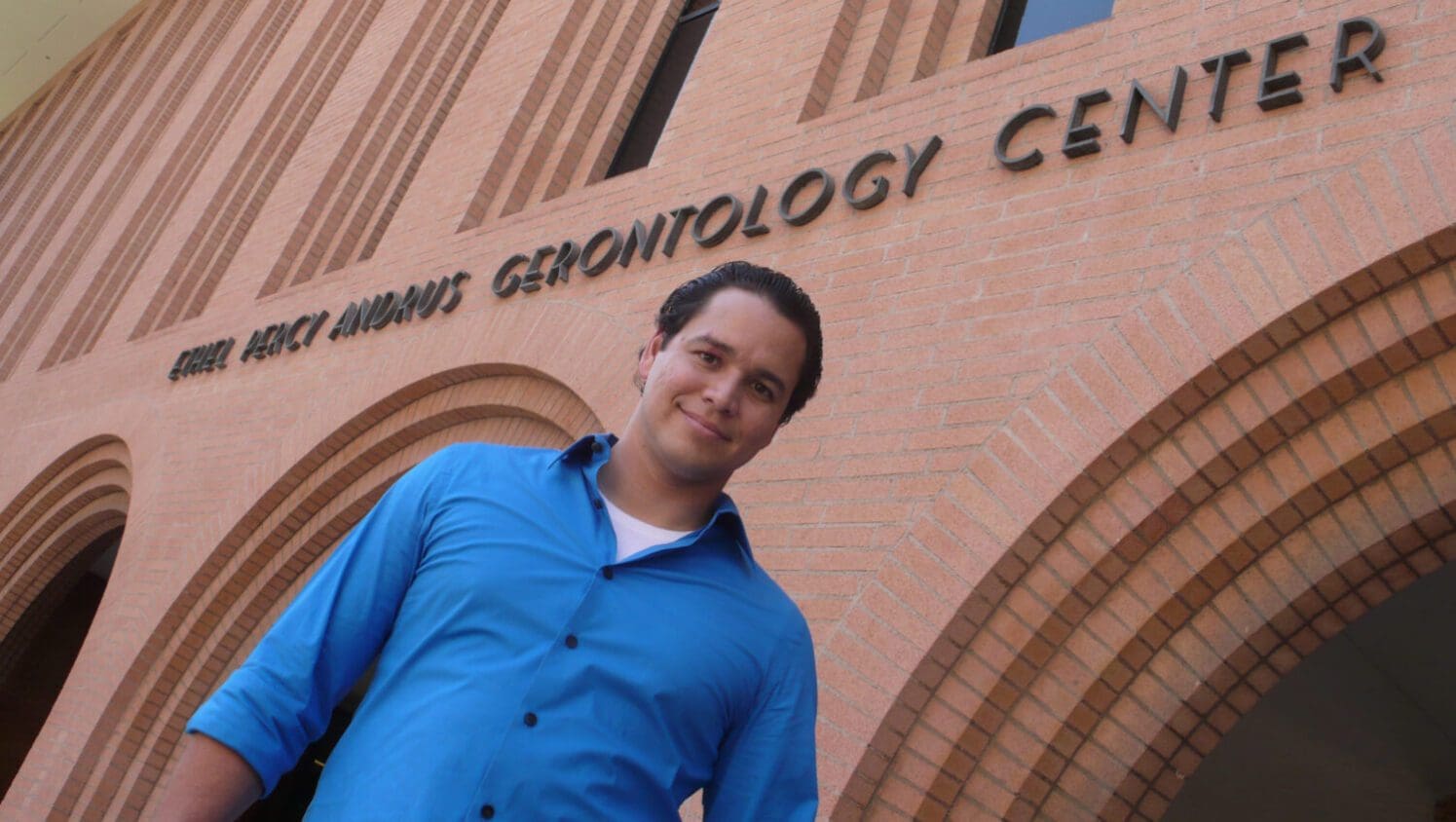
Jeff Laguna outside USC Leonard Davis School

Student Wins Award for Groundbreaking Paper on Minority End-of-Life Pain Management

By Caregiving, Featured, Honors and Awards, Student Profile
USC Davis School of Gerontology doctoral student Jeff Laguna (Photo/Trevor Nelson)

USC Leonard Davis School of Gerontology doctoral student Jeff Laguna (Photo/Trevor Nelson)

End-of-life pain is poorly managed across the board, but why, even with palliative care efforts, do minorities suffer disproportionately?

Tackling what he calls the first study to investigate pain experiences among Whites, Blacks and Latinos following inpatient palliative care (IPC) consults, USC Leonard Davis School of Gerontology doctoral student Jeff Laguna won the Gerontological Society of America’s Elaine M. Brody Award, given for excellence in research.

Co-authored with Rebecca Goldstein, MD, and USC Leonard Davis School Hanson Family Trust Assistant Professor of Gerontology Susan Enguídanos, PhD, MPH, the study was funded by the Archstone Foundation, examining 484 seriously ill patients and how their racial/ethnic differences impacted their end-of-life pain.

“We found something very interesting. Although palliative care did a great job at reducing pain among a racially/ethnically diverse patient population, it seems that Latinos were still more likely to report pain at hospital discharge,” Laguna said. “Previous research suggests a couple possible explanations, but a more detailed study will be needed to understand why Latinos appear to respond differently.”

Some of the existing explanations include the potential for Latinos to view end-of-life pain as a time of necessary and even welcome personal and/or spiritual cleansing, highlighting Laguna’s findings that IPC interventions may need to increase cultural sensitivity. He also finds that this increased awareness will inform future policy changes, which could help revolutionize the way we think about end-of-life care.

“After decades of recognizing the existence of ethnic disparities in health care access and health outcomes, we are continuing to see these patterns today. Illuminating these disparities is a first step to understanding and overcoming them,” Enguídanos said. “Jeff’s commitment to investigating disparities and improving equitable quality of care is commendable and critical.”

“For me, this award is the culmination of a lot of hard work, as I had to travel halfway across the country to master the analyses performed in this study,” Laguna said. “It is my hope that this study opens the door for a more detailed investigation. While this is the first step of many, I believe that it is an important step.”

Bacteria Boy Band

By Featured

USC’s 2012 iGEM Team: (l to r) Rebecca Gao, Eric Siryj, Luke Quinto, Megan Bernstein, Sean Curran, Percy Genyk, Stephan Genyk, Ellen Park and Rachel Koha

Singing bacteria—a veritable Menudo made up of microorganisms—was the latest synthetic biology brainchild of USC’s International Genetically Engineered Machine competition (iGEM) team.

Advised by the USC Leonard Davis School of Gerontology assistant professor Sean Curran and grad student Percy Genyk, the team consisted of USC undergrads Megan Bernstein, Rachel Kohan, Ellen Park, Stephan Genyk, Eric Siryj, Luke Quinto and Rebecca Gao.

“From beginning to end, the team was committed—staying past midnight was very common,” said member Stephan Genyk. “I am proud of the many hours and long nights we put into this project, and that we were able to create an intricate system that can be used in many other fields of science.”

Building on last year’s initial success, where the USC iGEM team was able to instigate a “Trojan horse” self-destruction mechanism in antibiotic-resistant bacteria, this year’s iGEM team won a gold medal at the iGEM Regional Jamboree: Americas West in Palo Alto, CA for their project, “E. musici.”

“It is great to see that in the few short years since it was founded, the USC iGEM team won the gold medal,” said Yannis Yortsos, dean of the USC Viterbi School of Engineering. “This success demonstrates the caliber of our undergraduate students in biochemical engineering and the leadership of its faculty advisor Sean Curran.”

Working with the infamous E. coli, the team manipulated the genetic factors responsible for the movement of the bacteria’s whip-like flagella. By controlling the rotation and frequency of the flagella under a variety of conditions, including pH, temperature and salt/nitrate concentration, the team were able to translate these specific changes into an audible range.

In effect: for the first time in history, bacteria were able to “talk” directly to scientists, providing feedback about their health and hunger levels, which could prove invaluable in any laboratory setting.

“The creativity, dedication and talent on display with this team is awe-inspiring,” said Pinchas Cohen, dean of the USC Leonard Davis School of Gerontology. “Seeing rising young USC scientists with such passion and innovation is a testament to the strength of the university and the future of the field.”

On a more lighthearted level, the team’s project also translated into an ability to potentially create an E. coli keyboard, with each note represented by a plate of bacteria producing a specific frequency.

While the prospect of bacteria Bieber covers may simultaneously charm and terrify, the team prided itself on spanning the divide between the arts and science while increasing public awareness of the limitless potential of bioengineering. In fact, they also produced an outreach video and social media initiative exploring people’s misconceptions of synthetic biology while explaining some of its basic concepts and applications.

“iGEM presents the perfect opportunity to combine biology, engineering, computer science, ethics and public relations in the cutting edge field of synthetic biology,” said Rebecca Gao. “We all wanted to pull something with the ‘wow,’ double-take factor and it was amazing to see our crazy, ‘Wouldn’t it be cool if?’ questions actually manifest themselves.”

“Being a part of the iGEM team this year was one of my most rewarding experiences here at USC. I got to learn hands-on bench science and gain research experience,” said Megan Bernstein. “Sometimes the best way to really learn is to do something, and participating in an iGEM project is an amazing example of that.”

“This type of interdisciplinary, discovery-based learning is fundamental to training our undergraduates to be leaders in the fields of tomorrow,” said Steve Kay, dean of the USC Dornsife College of Letters, Arts and Sciences. “The USC Dornsife community is incredibly proud of this trailblazing team of scholars.”

While the team’s praise from the students for advisors Curran and Percy Genyk was universal, the feeling was definitely mutual.

“This year’s team was exceptionally enthusiastic and creative—no one had made E. coli sing before and it seemed impossible, so what better challenge?” said Curran, who also holds joint appointments in both USC Dornsife and the Keck School. “iGEM is a unique opportunity for undergrads to work on a project from development to presentation on a national stage, and I am so proud. I enjoyed working with this team so much and I can’t wait to see what they accomplish in the future!”


For more information on the team, their project and their videos, visit http://2012.igem.orgTeam:USC.

From The Netherlands to Los Angeles

By Featured

From Oct. 8-12, 2012, the USC Leonard Davis School of Gerontology welcomed delegates from The School of Applied Gerontology at the Windesheim University of Applied Sciences in Zwolle, the Netherlands.

For one week, Hugo van den Beld, M.A., professor Carolien Smits, PhD and Annelies Harps-Timmerman, MSc, RN met with the School’s faculty, staff and students; toured Southern California senior services and explored opportunities for collaboration between the institutions.

“We wanted to help advance the situation of older adults in both countries, to enhance the profile and visibility of the two schools and to create new opportunities for education, research and community projects,” said van den Beld, a USC Leonard Davis alum.

Smits, too, had a very personal connection with the School: founding USC Leonard Davis dean James Birren, widely acknowledged as the father of the field, had visited her grad school class 30 years ago in Nijmegen, The Netherlands.

“We had been told about his insights and the pioneering work of the Davis School, and his lecture impressed us a lot. What’s more, we were invited to join him for lunch. This was quite unexpected to us as modest students,” she said. “Jim Birren was sincerely interested in what students thought about gerontological matters. This taught me that no matter what age you are and how prestigious your work, you can always learn from and with students. I still try to practice this, thirty years onwards.”

Continuing this international collaboration was of utmost importance to the team, who faced challenges in their own country with many people unsure as to what gerontology even is.

“This was a fantastic opportunity for us to learn from a university where they have many years of experiences in the field we’re teaching,” Harps-Timmerman said. “Besides that, we were eager to explore options for Dutch students and lecturers to go abroad and learn from other cultures and countries. It’s a very powerful way to learn.”


As part of their visit, the trio also presented a special lecture, “Going Dutch: Aging in The Netherlands,” exploring innovations in senior housing, long term care and community services as well as holding a special workshop with members of the USC Leonard Davis School’s Fall Prevention Center of Excellence.

Building on the success of their visit, the team plans to expand their connection to the USC Leonard Davis School by looking into creating joint research and exchange programs and offering non-degree training opportunities.

“The response from our students and faculty to our Dutch visitors has been overwhelmingly positive, and we are excited to continue to explore the wonderful opportunities they have presented,” said Pinchas Cohen, MD, dean of the USC Leonard Davis School. “Gerontology is a truly global field of study and we are eager to promote the increased quality of life for older adults in every country.”

“Both of our Schools have a lot in common and this is a great beginning to a beautiful partnership,” van den Beld said. “We would like to thank everyone at the Davis School who has helped make this visit such a great one. We hope to see them again very soon, either in LA or in the Netherlands!”

Crimmins Elected to the Institute of Medicine

By Featured

Eileen Crimmins, PhD, AARP Chair of the USC Leonard Davis School of Gerontology, capped off an impressive year with her election to the Institute of Medicine (IOM), one of the world’s most prestigious honors in the fields of health and medicine.

Building on her momentum, which included being named the winner of the Gerontological Society of America’s Robert W. Kleemeier Award, Crimmins was recognized for her academic and professional excellence as one of the globe’s top biodemographers.

“We are enormously proud of Eileen’s well-deserved honor, which is a testament to her brilliance and unparalleled reputation,” said Pinchas Cohen, MD “Her awe-inspiring career has pushed forward the boundaries of science and human knowledge by leaps and bounds.”

“As an international leader in the demography of human aging, Dr. Crimmins is one of USC’s most distinguished multidisciplinary scientists,” said her colleague, Caleb Finch, PhD “She is fearless in tackling new technologies and is not just one of the pioneers of her field, but one of its most impressive visionaries and leaders.”

An expert on health, mortality and life expectancy, Crimmins is also the director of the USC/UCLA Center on Biodemography and Population Health, director of the Multidisciplinary Training in Gerontology Program and a co-investigator of the Health and Retirement Study in the U.S.

“I am honored by this election,”Crimmins said. “It would not have been possible if I had not spent most of my career in the exciting multidisciplinary atmosphere at the Davis School of Gerontology at USC, a university that showed vision in providing this academic setting.”

The IOM is the health arm of the National Academy of Sciences, which was originally chartered under then-president Abraham Lincoln in 1863. Membership reflects the pinnacle of professional achievement and commitment to service for those chosen.

In Memoriam: David A. Peterson, PhD

By Featured

After a long battle with Parkinson’s disease, USC Leonard Davis School of Gerontology professor emeritus David A. Peterson died on Thursday, October 4, 2012.

Peterson was an expert on lifelong learning who served as director of the USC Leonard Davis School from 1978 to 2003. He was appointed the first holder of the Edward and Rita Polusky Chair in Education and Aging in 1999 and, in 2007, saw the Association for Gerontology in Higher Education create an award in his name.

“He was an early leader in the field of gerontology,” said James Birren, founding dean of the USC Leonard Davis School and widely considered the father of gerontology. “His background was in education, but he soon embraced more aspects of human life and aging.”

Peterson also served as associate dean of the USC Leonard Davis School from 1985 to 2003. He was responsible for the school’s instructional programs, including the development of the bachelor of science, master of science and the PhD degrees in gerontology as well as dual-degree programs with 10 other USC schools and departments.

“Our son was with me when David died. It has been a long difficult passage for David and for those who love him, but now he is at rest,” said his wife Ellen Peterson in email. “I do thank you for your appreciation of David as your colleague and friend. Thank you for your support of me as well.”

A date has not yet been set for the memorial service, but according to faculty, staff and students of the USC Leonard Davis School, Peterson and his accomplishments will never be forgotten.

“I speak for everyone associated with the USC Leonard Davis School when I say what an amazing mind and spirit David A. Peterson had, and what an enormous impact he had on the field,” said dean Pinchas Cohen, MD “It is with great sadness that we say goodbye, but we are proud to honor his exceptional life and legacy.”

UPDATE: Memorial Service: Saturday, October 27, 11:00 A.M., First United Methodist Church Chapel, 500 E. Colorado Blvd., Pasadena, 91101. There will be a reception following.

Memorials can be given in the form of contributions to the USC Leonard Davis School of Gerontology: David A. Peterson Scholarship OR David A. Peterson Fellowship. (USC Leonard Davis School of Gerontology, 3715 McClintock Ave., Los Angeles, CA 90089)