

The USC Age Tech Symposium, held in March 2025 as part of the school’s yearlong 50th anniversary celebration, was more than a gathering of experts and titans in aging, health care, tech and venture capital. It was a declaration of how USC is positioning itself as the global epicenter for age-tech innovation.
A prominent voice in this movement is Arnold Whitman, a veteran investor whose passion for aging solutions has helped catalyze a new era of interdisciplinary collaboration. Whitman, founder of the Senior Living Transformation Co. (SLTC) and managing partner at Generator Ventures, has spent over four decades investing in senior care.
A member of the USC Leonard Davis School Board of Councilors, he recently created the Arnold M. Whitman Aging and Technology Initiative Fund to support the school’s efforts in this area, which helped make the Age Tech Symposium possible. His pivot toward technology marks a profound shift — not just in his career, but also in how aging itself is being approached. “Aging sucks,” Whitman said candidly during the symposium. “But it doesn’t have to.”
A Crisis — and an Opportunity
The demographic imperative is clear. As USC Leonard Davis School of Gerontology Dean Pinchas Cohen noted in his opening remarks, the world’s population pyramid has morphed into a rectangle, with older adults now outnumbering children under 18. This shift has created a caregiving crisis, one that demands technological intervention. Whitman’s response has been both visionary and pragmatic. He sees aging not as a burden, but as a frontier for innovation — where empathy, data and design converge to create solutions that are both socially and economically valuable. “There are very few businesses today where you actually create value in both ways,” he said. “Technology can reduce administrative burden and enable the human element to flourish.”
From Real Estate to Revolution
Whitman’s journey began in real estate investment trusts and senior living operations. But after moving to the West Coast over a decade ago, he began exploring how technology could transform the aging experience. That curiosity led him to Aging 2.0, a movement he helped pioneer, and eventually to USC. His relationship with the USC Leonard Davis School began in 2012, when Cohen identified Whitman as a key figure in bridging gerontology and innovation. Their shared vision — of integrating app development, data science and human-centered design into aging services — has since blossomed into a robust partnership.
“Arnie has been a mentor to me,” Cohen said. “His support for the school is tremendous.”
SLTC: A New Model for Senior Living
At the symposium, Whitman introduced SLTC, a company that embodies his belief that community is health care. SLTC’s flagship project in Nashville, Tenn., integrates assisted living with tech-enabled health care, creating a model that aligns operators, caregivers and residents around shared data and outcomes. “Socialization is a driver of well-being,” Whitman explained. “And well-being reduces health care costs.” SLTC’s interoperability platform, Centered Care, ingests data from residents, caregivers and technologies to create predictive and preventive care models. The goal is to extend length of stay, reduce hospitalizations and transform senior living into a proactive health environment. “We want to measure observational data and use it to intervene before problems escalate,” Whitman said.
Investing in Empathy
Whitman’s investment philosophy is rooted in empathy. He recounted a recent experience with Ellipsis, a startup using artificial intelligence-powered voice technology to support post-hospital care. The system’s ability to engage an 85-year-old patient with compassion and clarity was, in his words, “unbelievable.” “If they didn’t tell you it was a bot, you’d think it was a human,” he said. “The empathy was remarkable.”
This kind of technology, Whitman said, can scale care without sacrificing humanity. By automating routine tasks, providers can focus on connection — on being present, rather than buried in paperwork.
The Venture Capital View
David Krane, CEO and managing partner of GV (formerly Google Ventures), brought a venture lens to the conversation. He stressed that age-tech startups must understand how their solutions fit into existing health care systems — and be able to demonstrate return on investment. “Cool technology isn’t enough,” said Krane, who is the newest member of the USC Leonard Davis School Board of Councilors. “You need deep understanding and measurable impact.”
Krane also highlighted the role of AI in accelerating scientific discovery, particularly in therapeutics for conditions like dementia and cardiovascular disease. His optimism was echoed by fellow panelist Amir Dan Rubin of Healthier Capital, who described how AI is streamlining workflows and improving access.
“We’re seeing incredible use cases,” Rubin said, “from automating appointment scheduling to predicting health risks based on claims data.”
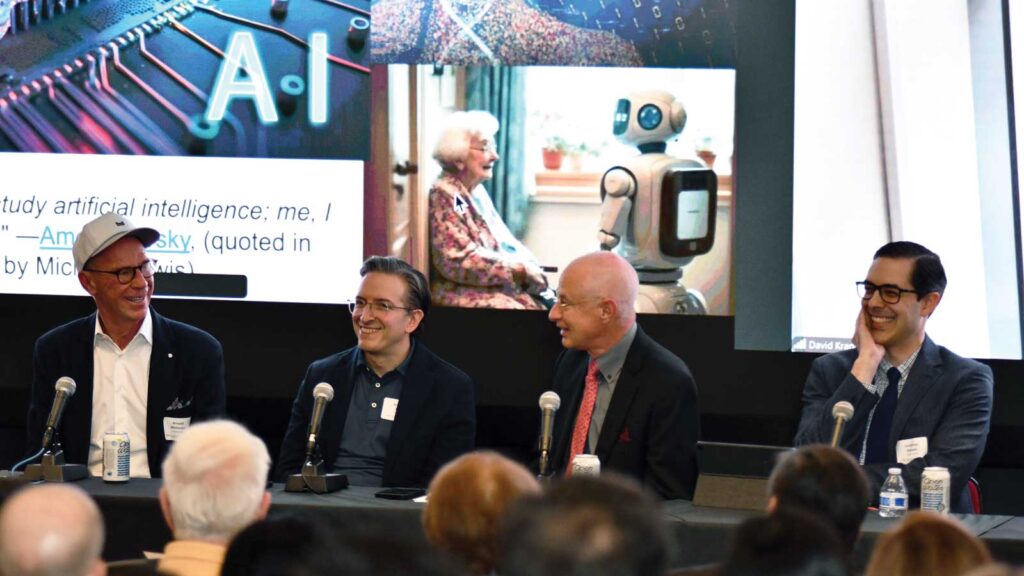
From left: SLTC founder Arnold Whitman, Healthier Capital CEO Amir Dan Rubin, USC Leonard Davis School Dean Pinchas Cohen, Jonathan Bandel of 22Health Ventures and GV CEO David Krane (via Zoom, not pictured) discuss investment in aging and technology during the USC Age Tech Symposium.
USC’s Role as a Catalyst
The Age Tech Symposium, offered in partnership with the USC Viterbi School of Engineering, showcased USC’s commitment to interdisciplinary leadership. From biomedical engineering to venture capital, the event brought together voices from across sectors to explore how aging and technology intersect. Steven Shapiro, USC’s senior vice president for health affairs, emphasized the university’s unique structure, which integrates all health science schools and systems. This allows for team-based care, collaborative research and rapid translation of innovation. “The future’s bright,” Shapiro said, “and USC wants to be a big part of that future.” The launch of the Master of Science in Applied Technology and Aging (MSATA) program further cements the USC Leonard Davis School’s role. Designed to train leaders fluent in both aging science and tech application, the program graduated its first student in 2024 and now boasts 18 enrollees.
A Global Perspective
While Whitman’s focus is domestic, the symposium also highlighted global challenges. Jonathan Bandel of 22Health Ventures, based in Singapore, spoke about Asia’s rapidly aging population and the cultural shifts affecting caregiving. “In Asia, adult children are moving to cities, leaving aging parents behind,” Bandel said. “Technology must fill that gap.”
From wearable devices to AI-driven diagnostics, the potential for age tech to address isolation, access and provider shortages is immense. Bandel emphasized the need for solutions that are culturally sensitive and scalable across diverse populations.
Designing for Inclusion
Keynote speaker Keren Etkin, author of The AgeTech Revolution, reminded attendees that technology must be designed with — not just for — older adults. Inclusion, she argued, is essential to creating meaningful solutions.
“Older adults are adopting technology,” Etkin said. “But they need support, and they must be part of the design process.” Her message resonated with Francesca Falzarano, a USC assistant professor of gerontology whose research focuses on caregiving and mental health and how tech might support caregivers. As a former caregiver herself, Falzarano emphasized the ripple effects of aging on families and systems. “It’s not just about older adults,” she said. “It’s about how we care for each other.”
Looking Ahead
As the symposium drew to a close, one theme stood out: Aging is not a siloed issue. It touches every facet of society — health care, housing, policy and technology. And it demands collaboration.
“The power of computing and the changing face of science play meaningful roles in giving us hope and optimism that will be able to accelerate discoveries and have a really profound impact on health care,” Krane said.
Whitman’s role in this movement is both foundational and forward-looking. His investments, mentorship and advocacy have helped shape USC’s age-tech vision. But more importantly, his belief in the human element — his insistence that empathy must guide innovation — offers a blueprint for the future.
“We’re at a defining moment,” Whitman said. “And I couldn’t be more excited.”
At the USC Leonard Davis School’s 2025 Vibrant Living Retreat, held at the Ojai Valley Inn in February, GV CEO and Managing Partner David Krane joined Dean Pinchas Cohen for a fireside chat that blended personal stories with bold visions for the future of health and technology.
Krane reflected on his path from a liberal arts degree to Silicon Valley leadership, crediting his upbringing in an academic household.
“As an only child, I had no choice except to hang out with adults and hang out with scientists and hang out with people that were endlessly curious about technology, about science and about the future,” he said.
That lifelong curiosity now drives his investment philosophy.
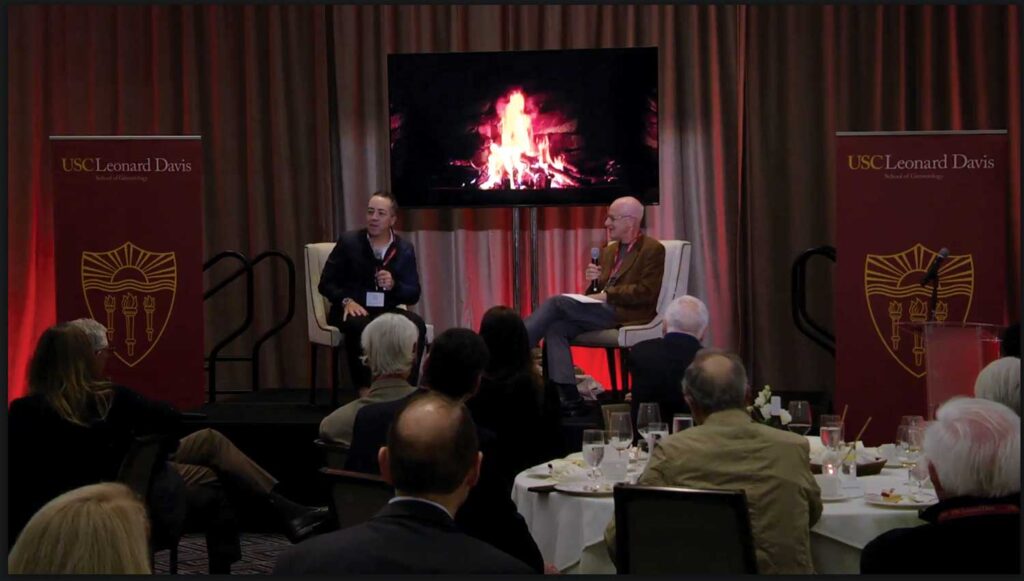
David Krane and Pinchas Cohen share personal stories and visions for the future of health and technology at the 2025 Vibrant Living Retreat. Photo courtesy of Ojai Valley Inn.
“One of the things that’s alluring to me about this general field is that it’s unseen and it’s neglected by many. And that agitates me and frustrates me,” Krane explained. “I feel like the general field of aging, age tech and the many, many other things that plug into this, they exist today. But I think we would all say if we were asked objectively, there’s a lot of room for improvement.”
He emphasized the need for proactive health care, citing companies developing whole-body imaging and early cancer blood tests. “The earlier we detect these things, the faster we can respond, and we can make a big difference if we do that,” Krane said. On investment strategy, Krane described looking for unexpected intersections: “Passion, expertise and, oftentimes, having that Reese’s Pieces moment, the sort of chocolate and peanut butter together — gene editing and heart disease — you come up with something big.” Krane also acknowledged the personal side of aging.
“I had my first moment literally in life where I said I might be aging. And it happened about 12.2 months ago. … I was given a diagnosis of something called sciatica,” he said with a laugh.
From AI-driven drug discovery to tackling environmental threats like microplastics, Krane urged continued collaboration between academia and industry: “We need to find a new way to bridge new connections to academia, to work together to solve hard problems.”